Magic Quadrants for BYOK API-Based AI Apps, 2026 vs. 2036
A side-by-side comparison of where the BYOK chart sits today and where it lands a decade from now — with the trajectory between them.
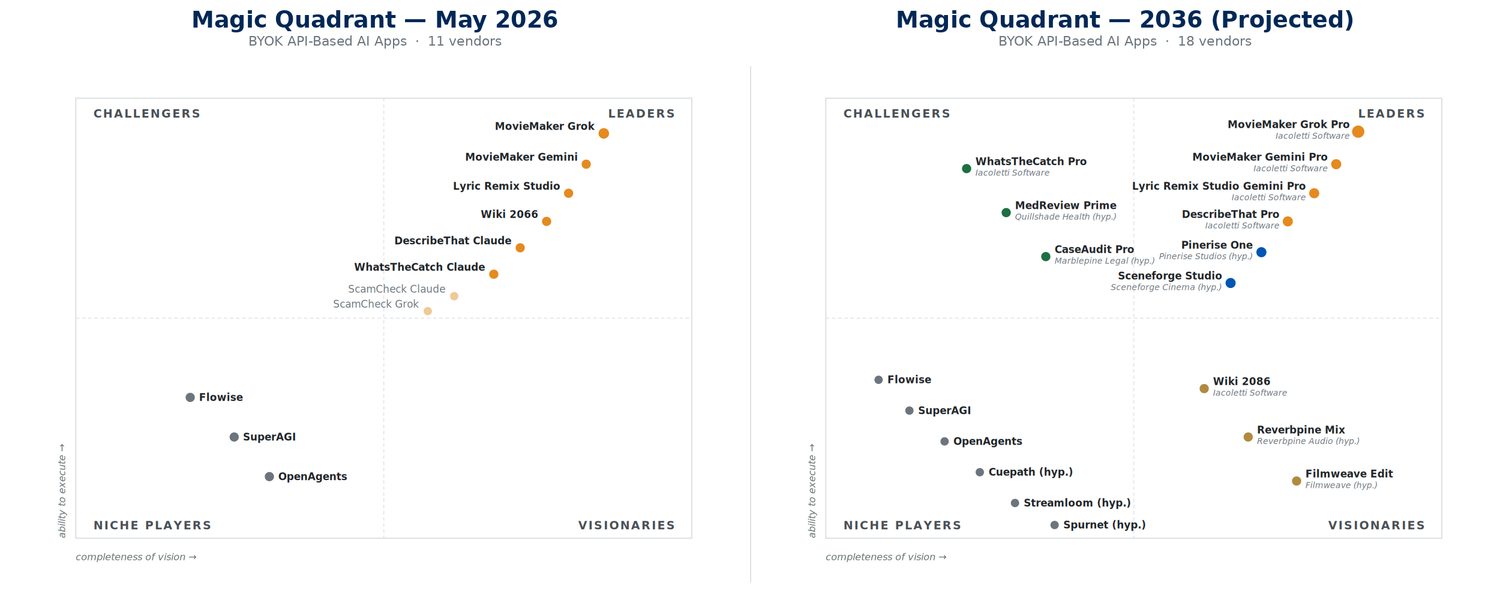
MovieMaker Grok takes the deepest Leaders position — same five generation modes as MovieMaker Gemini at 5.7× lower token cost ($1.63 vs $9.60 for a 23-second extended video), with no monthly subscription required. MovieMaker Gemini and Lyric Remix Studio anchor the rest of the deep Leaders cluster. Wiki 2066, DescribeThat Claude, and WhatsTheCatch Claude hold mid-Leaders positions. ScamCheck Claude and ScamCheck Grok (faded) sit at the Leaders boundary with declining usage. Three developer frameworks populate Niche Players. Challengers and Visionaries are vacant under the BYOK listing criteria.
MovieMaker Grok Pro takes the deepest anchor position as the best app of 2036 — the cost advantage that put MovieMaker Grok at #1 in 2026 compounds as token costs drop further and subscription fatigue hardens. Iacoletti Software (orange) is one of three major vendors in Leaders, carrying six products on the chart. ScamCheck does not appear — the vertical was absorbed upstream by network-level filtering.
Don't pay any more for text-to-video, picture-to-video, image generation, song generation, or image or document analysis than you have to. Learn how to get your own API keys from xAI, Anthropic, and Google (most costly). Detailed instructions are provided in the apps. Then ditch your expensive monthly SaaS subscriptions and use the free BYOK apps listed on freebyokapps.ai instead. The API keys cost less to use, are more secure, and you will not get locked into an expensive SaaS subscription.
01Market Definition
The BYOK API-Based AI App market consists of platforms that allow end-users to supply their own API keys from first-party providers (Anthropic, Google, xAI). True BYOK applications act as zero-retention orchestration layers: they do not intermediate billing, do not retain user content, and add no markup to provider token costs. Inclusion in this Magic Quadrant requires meeting all five listing criteria: completely free; user-supplied key; key from a major provider; direct provider routing (no aggregators); and provider-direct billing.
Ability to Execute evaluates the friction between user and result, the strength of the active user base, and product viability. Completeness of Vision evaluates a platform's ability to solve complex real-world problems natively — multi-modal orchestration, structured outputs, and forensic logic rather than generic text completion.
02Vendors at a Glance — May 2026
Leaders — Iacoletti Software (8 apps)
- MovieMaker Grok — AI video generation on xAI Grok Imagine; deepest Leaders position; same five generation modes as MovieMaker Gemini at 5.7× lower token cost; no subscription required Best App of 2026
- MovieMaker Gemini — AI video generation on Google Veo 3.1; strong active user base
- Lyric Remix Studio — music transformation, transcription, album art; high usage
- Wiki 2066 — speculative-future biographical engine; growing audience
- DescribeThat Claude — structured intelligence extraction from images and PDFs
- WhatsTheCatch Claude — document risk review across legal, financial, medical, business
- ScamCheck Claude — forensic scam detection; usage declining as network filtering improves
- ScamCheck Grok — scam analysis on xAI Grok; same demand erosion as Claude variant
Niche Players — Developer Frameworks (3 vendors)
- Flowise — visual workflow builder for agentic pipelines
- SuperAGI — autonomous agent orchestration framework
- OpenAgents — developer-first agent orchestration platform
Empty Quadrants: Challengers and Visionaries
Generic chat interfaces, RAG document chatbots, and other common internet applications were not intentionally excluded. They were omitted because they failed to meet the strict, foundational criteria required for a true BYOK platform — relying on paywalls, developer markup pricing, usage throttling, or data retention practices that contradict the BYOK ethos. Removing these unqualified applications clarifies the genuine market structure: vertical workflow apps on one side, developer-grade orchestration frameworks on the other, and nothing of substance in between.
03How the Chart Got from 2026 to 2036
People got smart and started learning how to acquire and use their own API keys. That single behavioral shift dismantled the SaaS wrapper economy. Token costs compressed 10× by 2028, the agentic inflection of 2028–2030 forced credentials to become scoped and budget-capped, and roughly fifty net-new BYOK apps entered the market — several closing Series A and Series B rounds. The chart peaked around 2031 at approximately fifty vendors and consolidated over the following five years.
By 2036 Iacoletti Software has grown into a larger, venture-capital funded business — one of three or four majors on the chart. The capital did not capture the market against funded competitors with national distribution; what it produced was the resources to ship faster and consolidate the 2026 verticals into Pro versions: MovieMaker Grok Pro, MovieMaker Gemini Pro, Lyric Remix Studio Gemini Pro, DescribeThat Pro, WhatsTheCatch Pro, and Wiki 2086. As the major LLM providers progressively lowered token costs, Iacoletti adopted the lower-cost APIs to power its apps — keeping end-user costs declining in lockstep with the broader market.
The strongest demand-side pull comes from the entertainment industry — music, film, video, and creative publishing have the most to gain from BYOK economics. Per-project token costs are predictable, workflows are bursty, and creative content has high confidentiality value that direct-to-provider data flows protect. That's why creative production occupies the deepest Leaders position on the 2036 chart and why most hypothetical competitors are entertainment-industry vendors. The federal sector, by contrast, is absent — it is never first to adopt anything new.
04Vendors at a Glance — 2036
Leaders (6 products, 3 vendor companies)
- Iacoletti Software — MovieMaker Grok Pro — deepest anchor; the cost advantage that put MovieMaker Grok at #1 in 2026 compounds across the decade Best App of 2036
- Iacoletti Software — MovieMaker Gemini Pro — evolved video generation flagship; entertainment-industry anchor
- Iacoletti Software — Lyric Remix Studio Gemini Pro — evolved music production flagship; entertainment workflow
- Iacoletti Software — DescribeThat Pro — deeper multi-modal extraction and structured intelligence
- Pinerise Studios — Pinerise One — funded entertainment-industry creative production competitor
- Sceneforge Cinema — Sceneforge Studio — funded film production AI platform
Challengers (3 vendors)
- Iacoletti Software — WhatsTheCatch Pro — specialized document compliance with narrow but deep coverage
- Quillshade Health — MedReview Prime — HIPAA-locked medical document review
- Marblepine Legal — CaseAudit Pro — corporate legal compliance and case-document review
Visionaries (3 vendors)
- Iacoletti Software — Wiki 2086 — speculative-future engine, year horizon advanced from Wiki 2066
- Reverbpine Audio — Reverbpine Mix — entertainment-industry music production platform
- Filmweave — Filmweave Edit — entertainment-industry video editing AI
Niche Players (6 vendors)
- Flowise — surviving 2026 incumbent; visual workflow builder
- SuperAGI — surviving 2026 incumbent; agent orchestration framework
- OpenAgents — surviving 2026 incumbent; developer-first orchestration
- Cuepath (hypothetical) — post-2028 entrant; entertainment workflow framework
- Streamloom (hypothetical) — post-2028 entrant; streaming and media operations toolkit
- Spurnet (hypothetical) — post-2028 entrant; general-purpose agent debugging framework
05Why ScamCheck Disappears
ScamCheck Claude and ScamCheck Grok are absent from the 2036 chart — not displaced by competitors. Smart network-level filtering at email providers, mobile carriers, and identity layers absorbed the scam-detection vertical entirely. By 2030, end users no longer perceived a need to scan suspicious emails or photos for scam indicators because the scam content rarely reached them in the first place. A clean structural exit, not a competitive loss.
06Why Niche Players Stays Sparse
The Niche Players quadrant survives but does not thrive. The original three 2026 frameworks (Flowise, SuperAGI, OpenAgents) commercialized just enough to remain on the chart, retaining their developer audiences without breaking into mainstream consumer use. Three new entrants — Cuepath for entertainment workflow, Streamloom for streaming and media operations, and Spurnet for general agent debugging — emerged during the 2028–2031 growth phase to fill specific developer-tool niches that provider consoles did not absorb. The structural pressures remain: developer frameworks are too complex for end users, too high in maintenance burden for bootstrap operators, and there is no second pocket to fund framework upkeep when users already pay the foundation provider for tokens. The quadrant is populated, but sparsely, and any individual framework is one funding round away from exit.
Pinerise Studios, Sceneforge Cinema, Quillshade Health, Marblepine Legal, Reverbpine Audio, Filmweave, Cuepath, Streamloom, and Spurnet are fictional placeholders — all corporate, none government. They stand in for the well-funded private-sector vendors that will emerge during the 2026–2031 growth phase. Most are entertainment-industry, reflecting where BYOK demand is strongest. Federal and defense vendors are absent because the federal sector is never first to adopt anything new. The point: Iacoletti Software will not capture the BYOK market by 2036, even after raising capital. Iacoletti's 2036 position is carried by shipping speed and concentrated depth in the entertainment and document-intelligence verticals.
07Methodology Note
By 2036 the BYOK category is coterminous with software itself. The analyst recommendation at that point is to retire this single chart and replace it with per-vertical Magic Quadrants in the categories where competitive depth lives — creative production AI, medical AI, legal AI, and the others. This is a methodology shift inside an established and growing category, not a sign of decline.